The market for commercial and advertising print products has undergone massive changes in recent years. The key drivers of this development are the ongoing digitization of the media landscape, the increasing fragmentation of target audiences, and the demand for extremely short turnaround times. This is also reflected in companies’ marketing budgets. Print continues to play a central role, but must hold its own within the media mix. All these changes are further increasing the importance of digital printing and continue to drive its solid growth. Thanks to its flexibility, efficiency, and print quality, digital printing can specifically address the demand for greater flexibility—particularly in the commercial printing market—while also helping to tap into new business models and potential, especially when the strengths of offset printing are combined with those of digital printing. This includes the production of short runs as well as on-demand production or the personalization of print products—which goes far beyond simply adding a personal address to a mailing and now extends into the realm of “mass communication.”
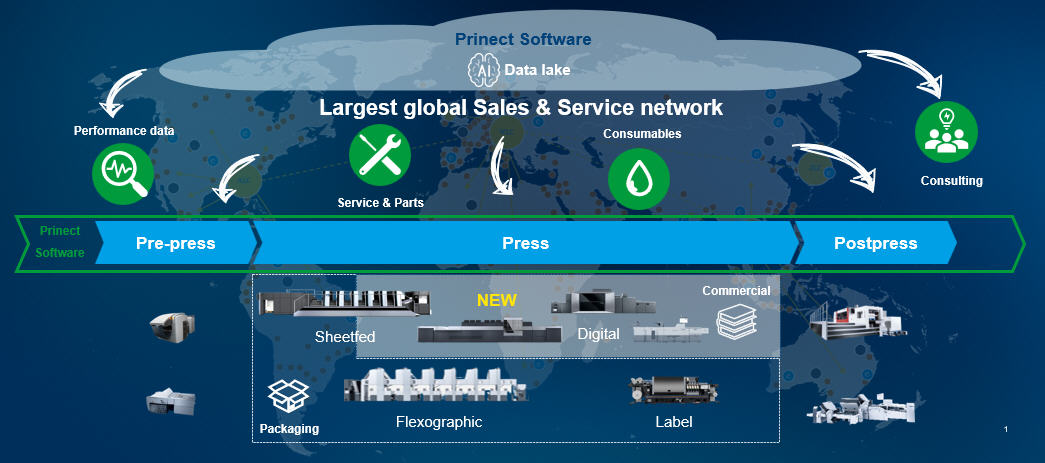
HEIDELBERG offers a powerful portfolio for digital printing, which the company integrates—along with its offset offerings—into a digital ecosystem comprising equipment, software, consumables, service, and training, and is gradually expanding with the Jetfire 75 for the B2 format.
Choosing the right printing technology is a strategic decision within a print shop’s digitalization strategy and influences organization, investment planning, and responsiveness to market changes. From a practical perspective, it makes sense to view toner and inkjet printing as appropriate solutions for different application requirements. Which technology is the best choice depends on the print service provider’s business model and, consequently, on applications, material mix, order structure, degree of automation, and economic conditions. A combination of toner and inkjet technology can also be beneficial, even in conjunction with offset printing. Integration into the existing workflow—which controls both offset and digital printing—is the key to a highly automated and hybrid print production process, where customers benefit from significant efficiency gains.
In commercial print shops in particular, digital printing has been an integral part of the technical equipment for many years. This is not surprising, since for approximately 65 percent of all commercial print jobs produced worldwide on a HEIDELBERG sheetfed offset press, print runs are under 2,000 sheets. This is evident from an analysis of the relevant machine data. Short or very short runs are typically produced digitally, while medium-sized or long runs are printed on offset presses. Both technologies therefore coexist and complement each other in a hybrid production environment.
HEIDELBERG entered the toner-based digital printing market 15 years ago through its partnership with Ricoh and the Versafire systems. Over the years, more than 3,500 systems have been sold and installed worldwide. These compact and versatile systems enable companies to position themselves in the market as flexible print service providers. With the third generation of Versafire, HEIDELBERG now offers users a mature, high-performance, and productive portfolio for the cost-effective and flexible production of short runs and personalized print products.
At drupa 2024, HEIDELBERG also expanded its portfolio toward industrial inkjet printing with the Jetfire 50. The company thus offers a flexible digital printing solution for the B3+ format. The first installations in international markets took place as early as 2025. In early 2026, the company also introduced the Jetfire 75, a highly productive inkjet printing solution for the B2 format.
All digital printing systems can be integrated into a print shop’s overall workflow via Prinect, which offers users a unique advantage. Inline finishing solutions are available for the Versafire, and nearline finishing solutions—such as HEIDELBERG’s Fireline as well as systems from C.P. Bourg and Tecnau—are also available for the Jetfire systems. HEIDELBERG thus underscores its role as a systems integrator in the printing industry, offering customers genuine added value.
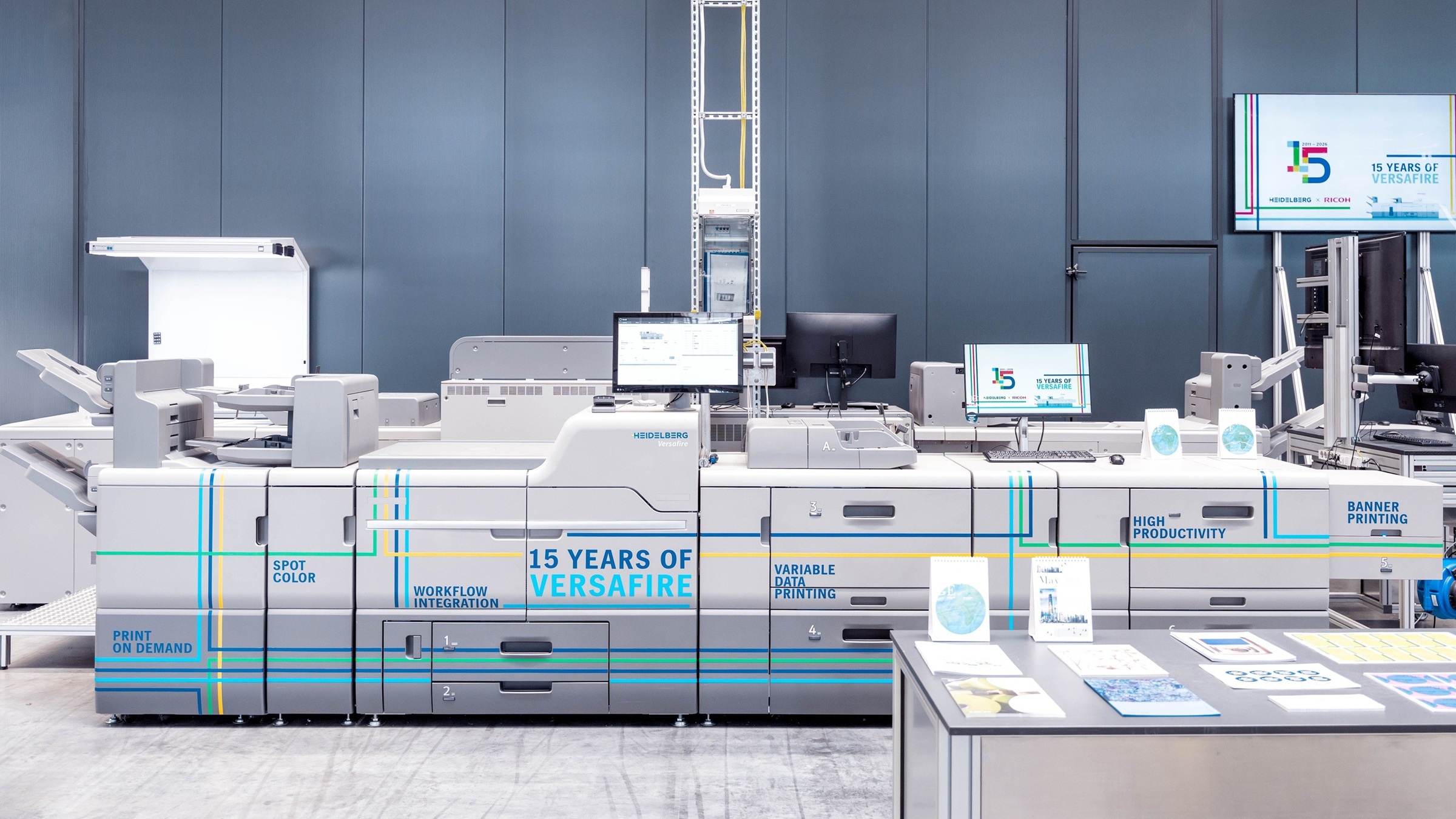
HEIDELBERG entered the toner-based digital printing market 15 years ago through its partnership with Ricoh and the Versafire systems.
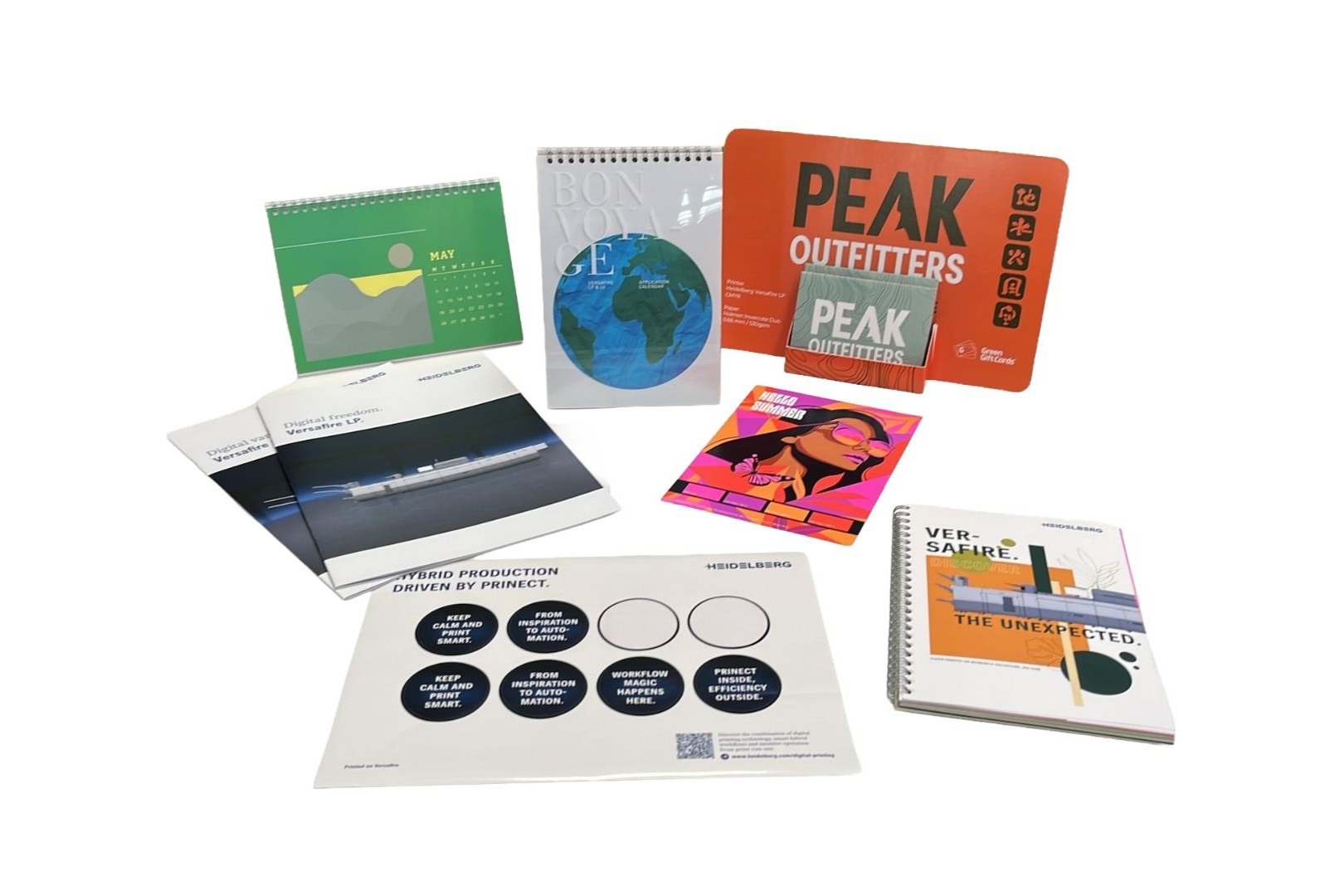
Today, digital printing stands out for its flexibility, efficiency, and print quality, helping users tap into new business models and opportunities. The photo shows typical applications for the Versafire systems.
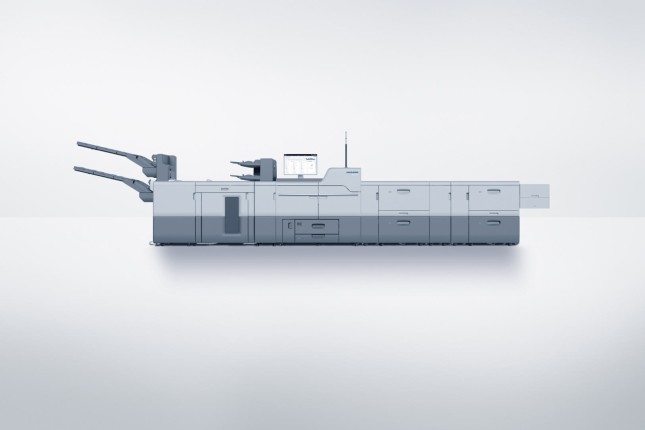
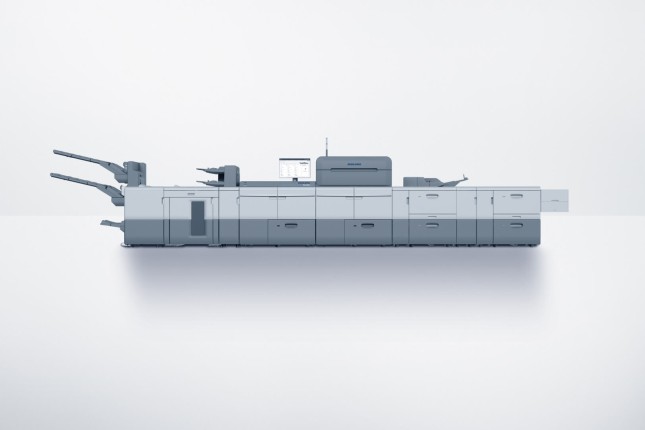
HEIDELBERG currently offers two toner-based digital printing systems: the Versafire LV and the Versafire LP. With its featuring seven special colors and a wide range of substrates, the Versafire LV demonstrates its flexibility in application. The grammage range extends from 40 to 470 g/m and, as an option, the Versafire LP can handle substrates up to 800 µm thick, expanding its range of applications to include folding cartons as well as high-quality calendars and photo books. Even synthetic materials can be processed using the Versafire LV. A typical application is race bibs for sporting events.
The special colors further expand the possibilities for designing creative print products—including silver, gold, neon yellow, pink, and white, which can also be overprinted to create “wow” effects in marketing campaigns. A clear varnish toner, which can also be applied selectively, adds extra gloss to the printed sheets. Typical applications include high-quality invitations, finished book and magazine covers, and posters that significantly increase attention at the point of sale. And “Invisible Red” is the gateway to security printing. Another interesting option is the range of long-sheet feeders, which can be used to print posters up to 1,260 mm in length, as well as six- or eight-page brochures and book covers— (four-page A4 landscape or eight-page A4 portrait)— even envelopes. Print shops whose business models include diverse or highly varied applications are therefore ideally positioned with the Versafire LV.
With a maximum output of 1.3 million A3 sheets per month, the Versafire LP is designed for higher print volumes; accordingly, the media cassettes are designed to hold up to 18,100 sheets. The Versafire LP boasts a maximum print speed of 4,500 A3 sheets per hour (simplex). The seven color station was deliberately omitted, as productivity is the top priority for the Versafire LP. In terms of substrate versatility, the Versafire LP is just as broadly equipped as the Versafire LV. On both systems, features such as automatic registration, calibration, inline color measurement, and content monitoring ensure exceptionally high production reliability. Various inline finishing units are available as options for both variants. Both systems can be operated as standalone units or integrated directly into HEIDELBERG’s Prinect workflow.
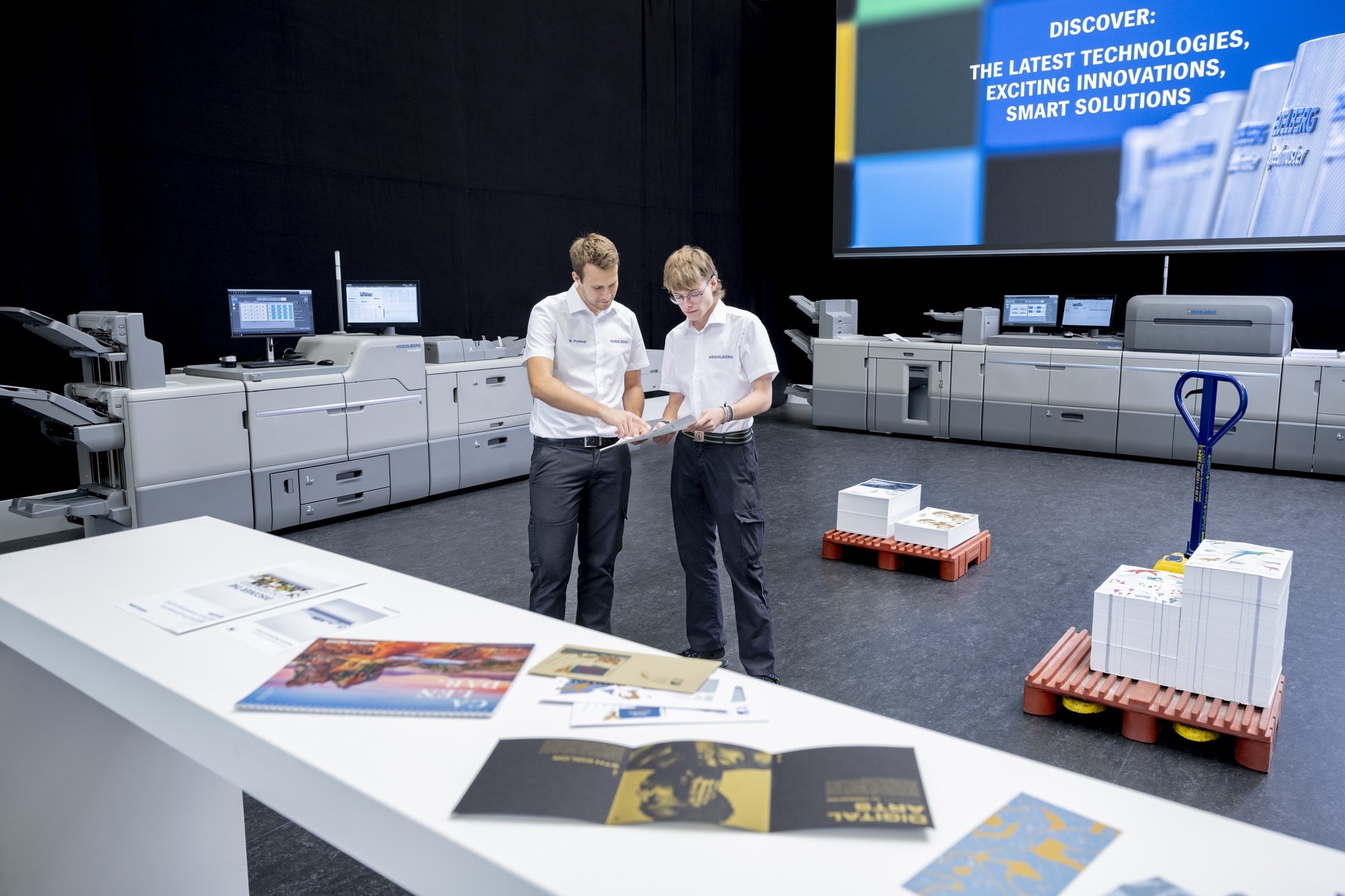
HEIDELBERG currently offers two toner-based digital printing systems:
the Versafire LV and the Versafire LP.
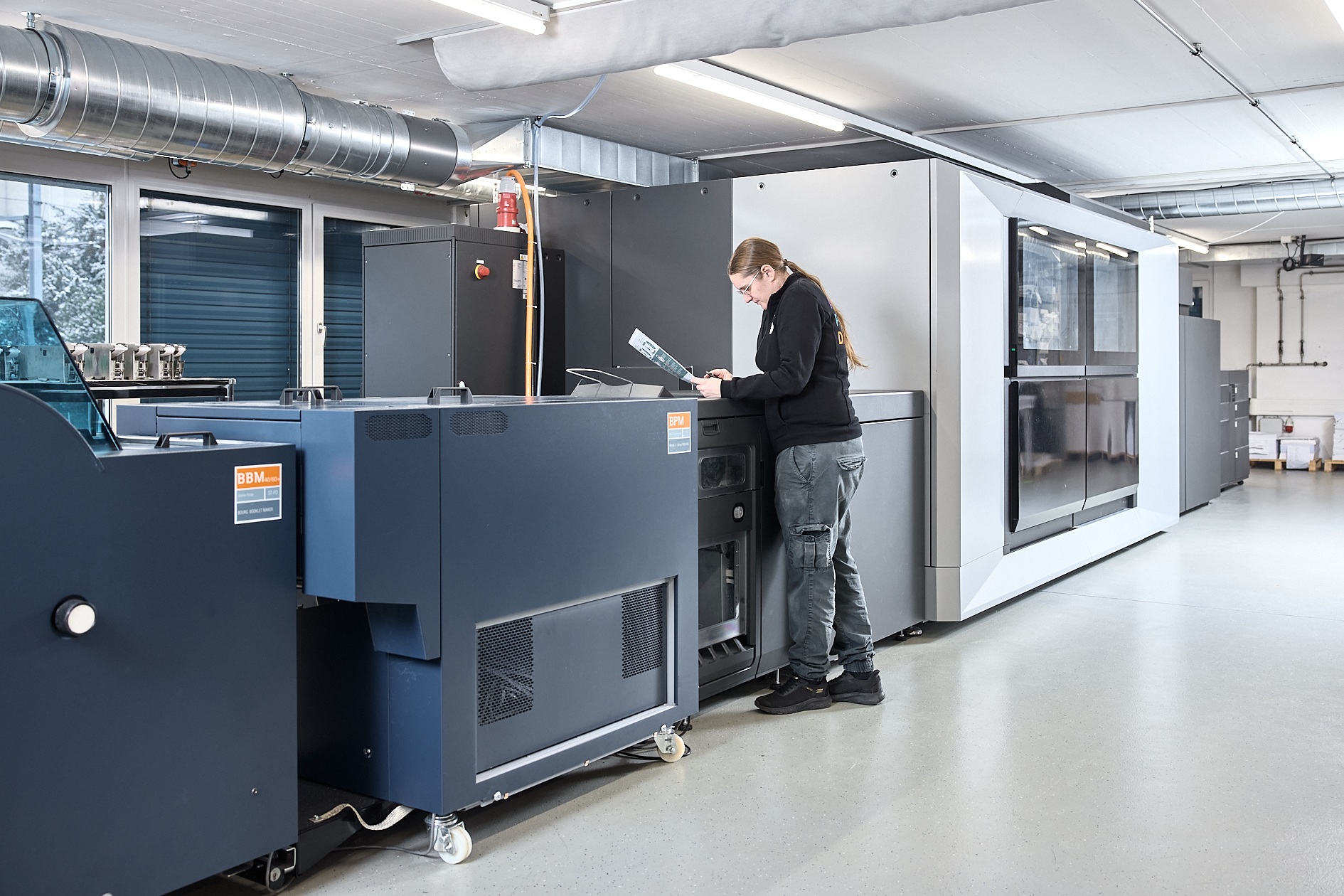
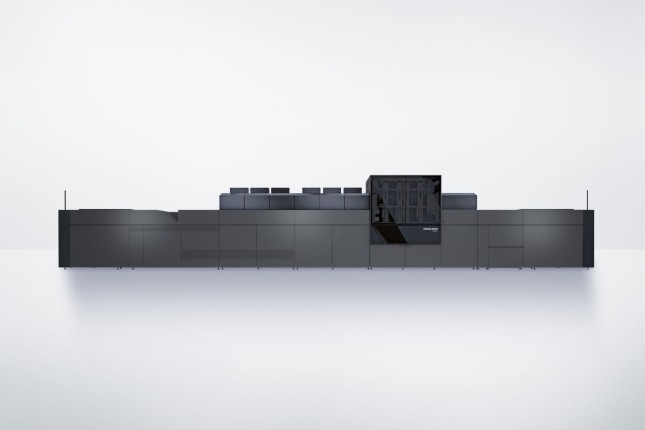
For industrial digital print production using innovative inkjet technology, HEIDELBERG has established the Jetfire 50 on the market. In combination with the AI-controlled Prinect Touch Free workflow, it can be optimally integrated into a hybrid production environment featuring both digital and offset printing.
With the Jetfire 50, HEIDELBERG has entered the realm of industrial-level productivity in digital printing, targeting high-volume commercial printers who want to future-proof their production by combining it with offset printing and gain a competitive edge in the market through on-demand production. This is evident not only in the print speed, which stands at 9,120 SAR3 sheets per hour (simplex), but also in the monthly print volume—up to five million SAR3 sheets (simplex), which is four times that of a Versafire LP—clearly demonstrating that the Jetfire is in a league of its own.
The Jetfire 50 uses water-based inks in CMYK mode. The grammage range is between 60 and 350 g/m²and the paper thickness between 70 and 400 µm. In terms of substrate variety, the Jetfire 50 focuses on coated and uncoated papers and cardboard. A major advantage for productivity-oriented users is the Jetfire 50’s high uptime, which stands at 90 percent—a factor that also has a positive impact on service intervals. HEIDELBERG also offers an optional long-sheet feeder for the Jetfire 50. The Jetfire 50 truly realizes its economic potential with larger volumes of medium-run jobs, consistent utilization, and a high degree of automation. Especially when combined with finishing solutions from C.P. Bourg, Tecnau, or HEIDELBERG’s Fireline, stapled and adhesive-bound products—such as brochures, catalogs, books, and much more—can be produced with high efficiency.
Today, digital printing systems are no longer isolated production islands but rather part of a networked production landscape. Intelligent workflows such as HEIDELBERG Prinect Production and, taking it to a whole new level, Prinect Touch Free reduce manual intervention to an absolute minimum, improve planning, stabilize processes, and lower error rates. In practice, this leads to shorter turnaround times, better capacity utilization, and greater process reliability.
With Prinect Touch Free, HEIDELBERG is opening a new chapter in the journey toward autonomous and hybrid production in the pressroom—going far beyond traditional automation. The system not only handles individual process steps but also controls the entire production workflow—from order receipt to delivery. With Prinect Touch Free, offset and digital printing are intelligently integrated into a seamless hybrid workflow, ensuring maximum efficiency with minimal manual intervention. This year, the new workflow will be available exclusively to Jetfire 50 customers.
Using AI, the native cloud software analyzes all possible layout variations, evaluates the entire order backlog, and automatically determines which process—offset or digital printing—represents the optimal production strategy, taking into account costs, on-time delivery, and capacity utilization. In doing so, the system continuously monitors all relevant production metrics, learns from the results, and thus continuously improves the quality of decisions for future orders.
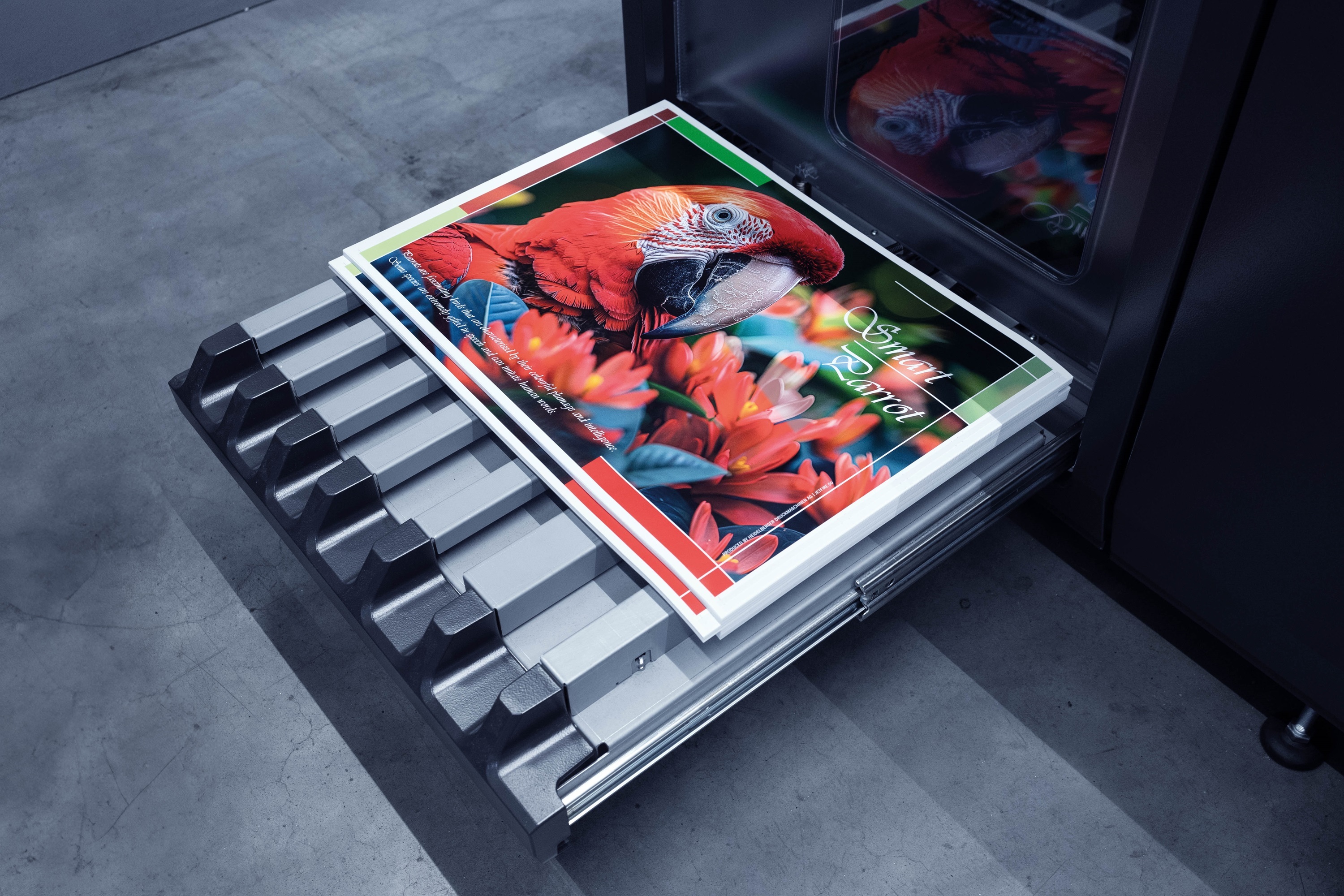
With the Jetfire 50, HEIDELBERG has entered the realm of industrial-level productivity in digital printing, thereby appealing to high-volume commercial printers.
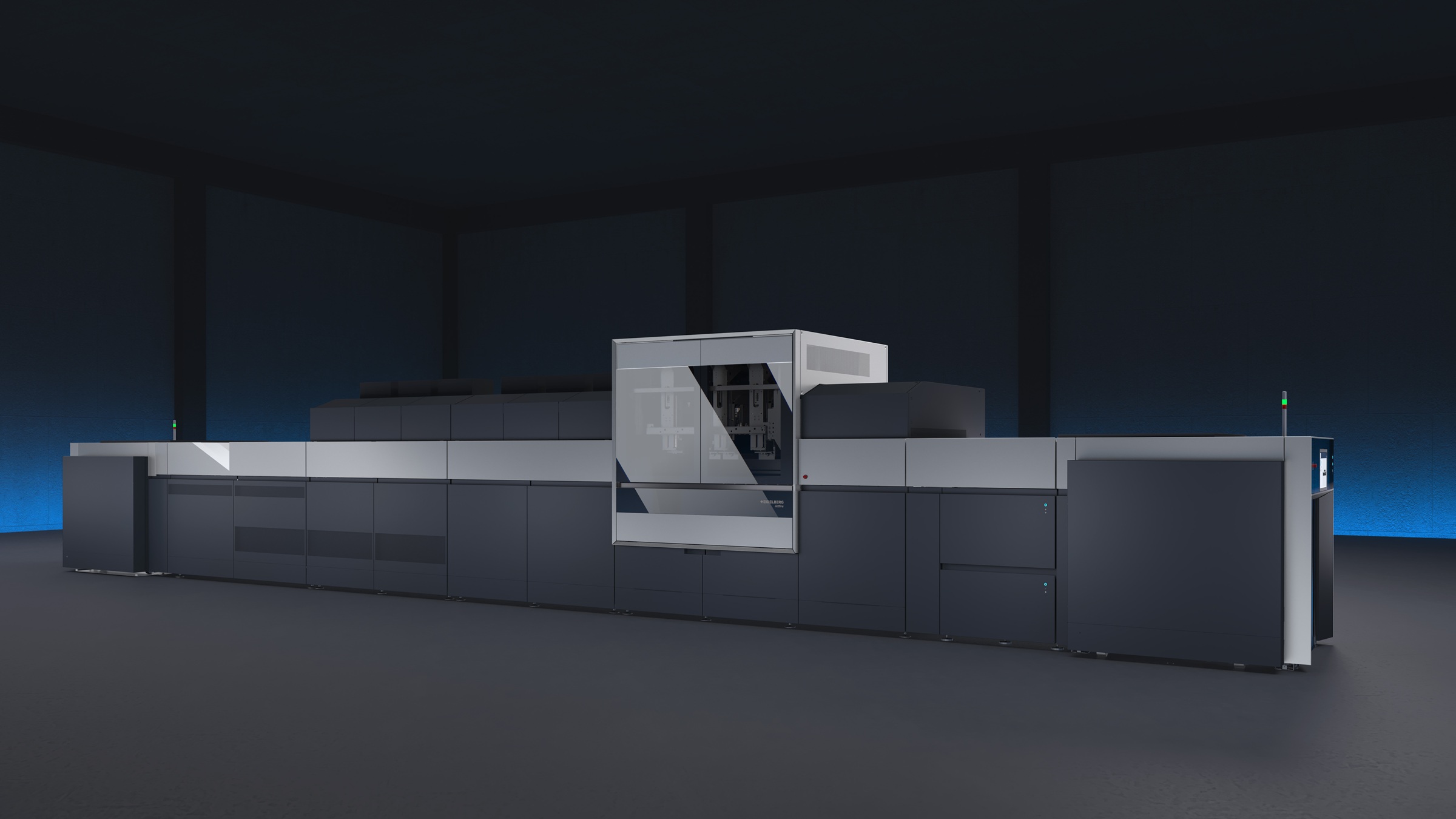
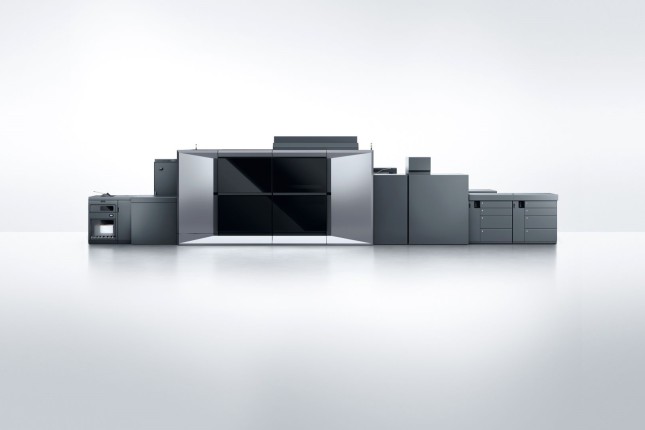
The upcoming Jetfire 75 is an industrial digital printing solution for the B2 format.
The issue of sustainability continues to gain importance in the printing industry as well, and here too, digital printing—toner and inkjet—is a promising approach to sustainable production, as individual process steps, such as the production of printing plates, are completely eliminated. The Jetfire 50 and Jetfire 75 from HEIDELBERG use water-based inks with very low emissions of volatile organic compounds (VOCs). The issue of deinkability—that is, the removal of toner or ink during paper recycling—has also been resolved. Furthermore, the high uptime of the digital printing systems contributes to sustainability, and HEIDELBERG customers benefit from the most comprehensive service network in the printing industry.
HEIDELBERG now offers a powerful portfolio for digital printing, which the company integrates—along with its offset offerings—into a digital ecosystem comprising equipment, software, consumables, service, and training, and is gradually expanding with the Jetfire 75 for the B2 format. Prinect Touch Free Workflow is the key technology for fully realizing the potential of a hybrid production environment combining digital and offset printing. Together with potential customers, HEIDELBERG’s digital printing experts analyze the existing order structure and potential for growth. This analysis determines the appropriate digital printing technology—whether toner, inkjet, or both.
| Criteria | Toner | Inkjet |
| Systems | Versafire LV/LP | Jetfire 50 |
| Resolution | 2,400 x 4,800 dpi | 1,200 x 1,200 dpi |
| Format | 330 x 487 mm | 356 x 508 mm |
| Max. monthly print volume (A3 pages) | 850,000/1.3 million | 5 million |
| Max. print speed (simplex) | 3,180/4,500 A3 pages/hour | 9,120 SAR3 pages/hour |
| Paper weight | 40–470 g/m² Versafire LP800 µm optional | 60–350 g/m² |
| Print Finishing | Yes (Versafire LV) | No |
| Long-sheet feeder | Yes (max. 1,260 mm) | Yes (max. 1,260 mm) |
| Availability | 75% | 90% |
| Integration/Workflow | Prinect Production or Prinect Touch Free | Prinect Production or Prinect Touch Free |